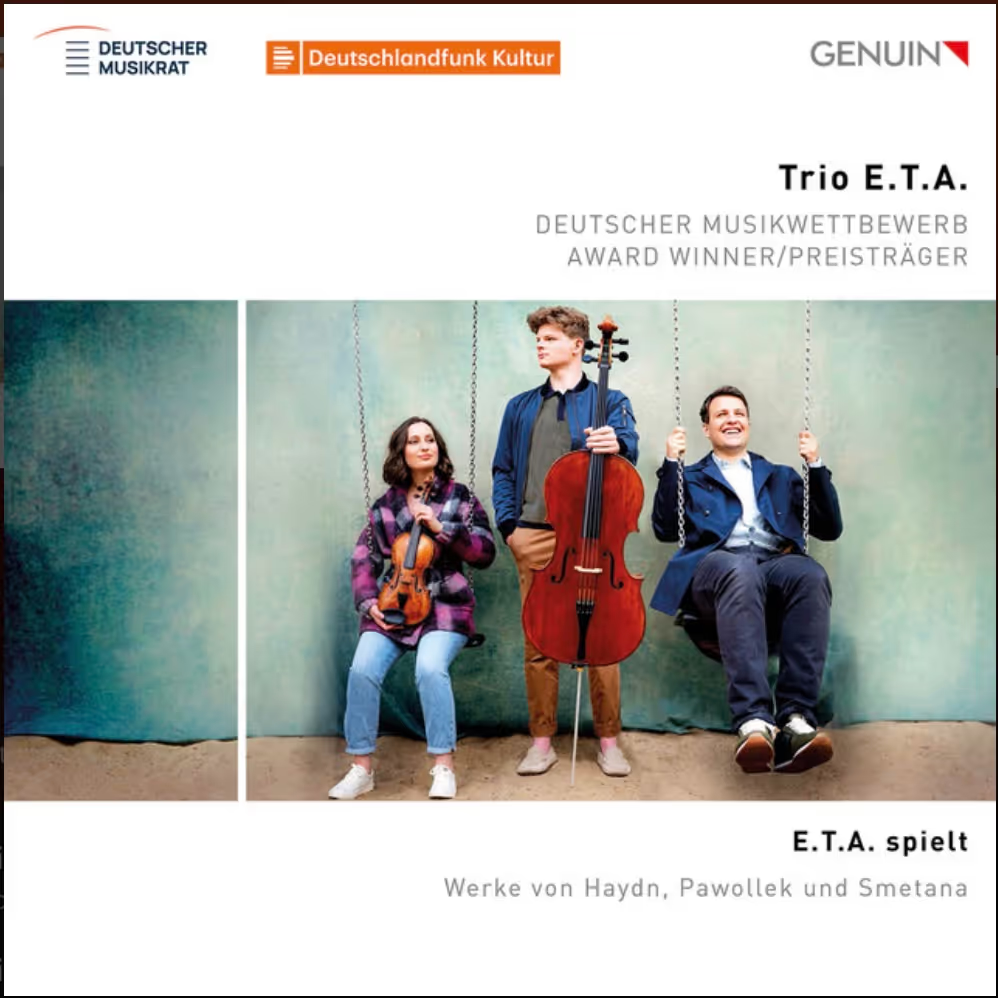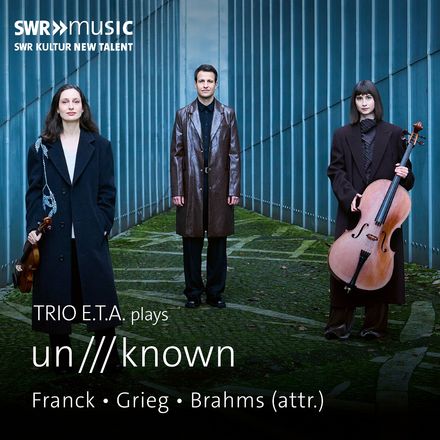
.jpg)
un///known


Three works, three worlds – and yet a shared core: the search for that moment when music transcends itself. César Franck’s youthful Trio in F-sharp minor bursts with creative energy, full of melodies that speak directly to the listener and a sense of freedom that opens up vast musical spaces. Edvard Grieg’s single movement for piano trio unfolds as a cycle of light and motion: searching, glowing, shimmering – a serious game that continually reinvents itself. The enigmatic Trio in A major, long attributed to Brahms, speaks in a warm, expansive voice, familiar in spirit and yet born from an unknown hand. Together, these works paint a panorama of chamber music: youthful and daring, poetic and searching, deeply rooted and full of unanswered questions. For Trio E.T.A., they become a reflection of its own musical identity: an ensemble united by alertness, curiosity, and the joy of creating sound together – always in search of that moment when three voices merge into a living dialogue. Recording Dates and Venue: 5–8 August 2025, SWR Chamber Music Studio, Stuttgart Producer: Eva Pobeschin (SWR) Artistic Supervision, Editing and Mastering: Stefanos Ioannou Sound Engineer: Boris Kellenbenz Liner Notes: Elene Meipariani, Maria Reich, Dr Michael Struck, Ruven Wegner Translation: Naxos Deutschland GmbH Booklet Editing: Naxos Deutschland GmbH Graphic Design & Layout: Manila Design Cover Photo: Kaupo Kikkas (with the kind support of the Deutsche Orchesterstiftung, the Rolf-Hans Müller Stiftung Baden-Baden, and MFG Baden-Württemberg) Booklet Photos: Jim Martin
Booklet
Piano Trio in F-sharp Minor by César Franck
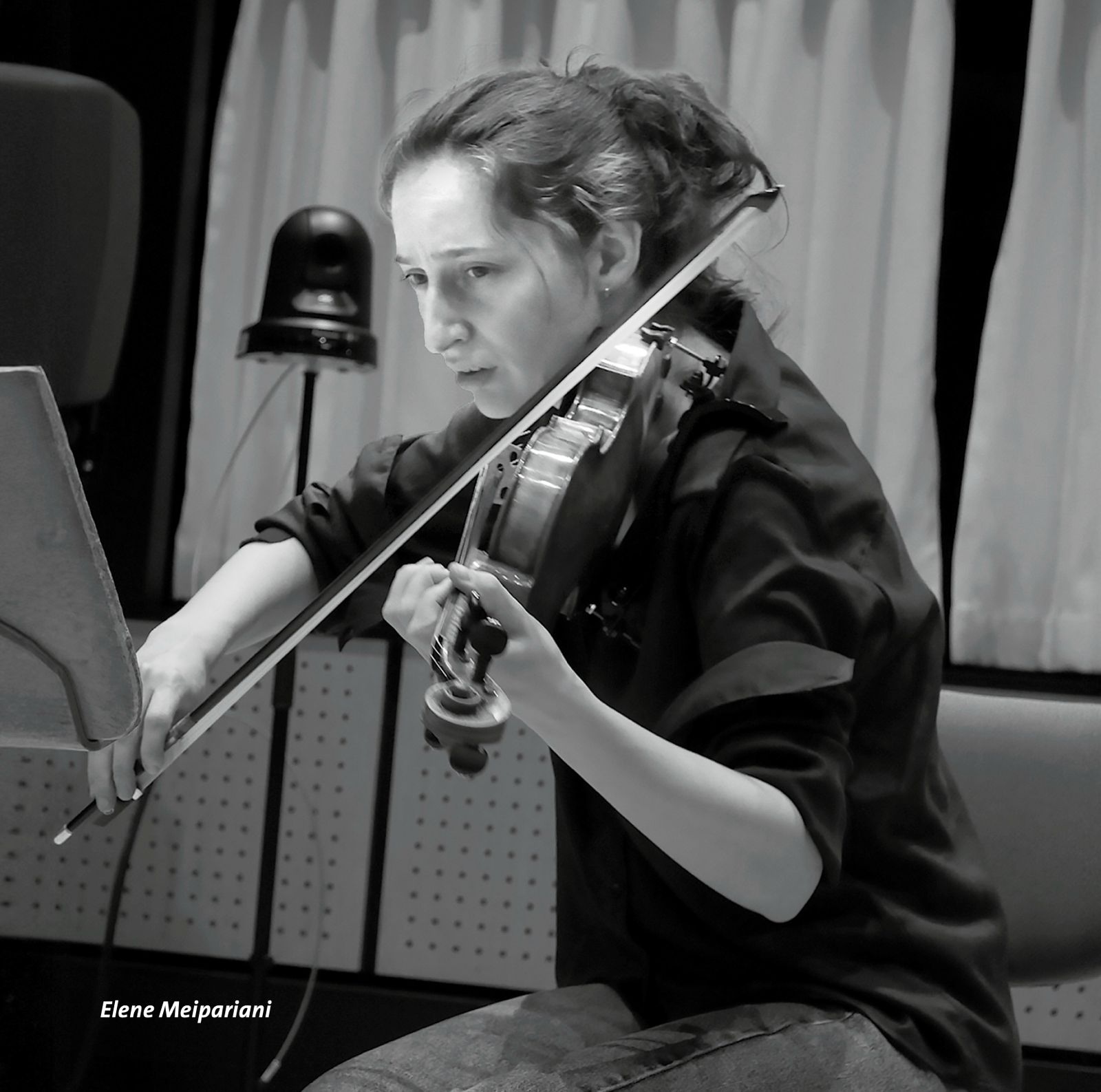
The Piano Trio in F-sharp Minor by César Franck has accompanied me since my earliest childhood. From the very beginning, I was in love with its beautiful melodies, its original ideas, and the emotional power that radiates from this work. It contains passages that we, as a trio, have never encountered in quite the same way in any other piece.
One such moment is the surprising unison F-sharp that, after a general pause, suddenly emerges as if out of nowhere, played simultaneously by all three instruments; or the second theme of the first movement, which is essentially nothing more than a simple scale – and yet it is precisely this simplicity that gives it such beauty and depth.
César Franck composed the trio at the age of seventeen. It is the first work of his cycle of three piano trios, published officially as Opus 1 – and at the same time the most convincing.
Written in 1841 as a musical calling card, it was meant to open doors for the young composer in the Parisian music scene.
For me, this work expresses youthful enthusiasm, great self-confidence, and an almost overflowing zest for life, for music, and for composing. At first glance, it may seem somewhat excessive – but to us, it feels more like the joyful outburst of a young composer who wants to say something of his own and who shares his hope and his love of music with every note.
This piece reminds me of a feeling that is sometimes hard to grasp – of that moment when, with youthful openness, you believe: everything is possible; of a creative force that knows no boundaries. César Franck’s first piano trio has, in a wonderful way, managed to capture precisely this sense of life – and to make it audible and tangible again and again.
For us, it is not only cleverly and boldly constructed, but also a work that gives us a sense of complete freedom on stage. A freedom carried by deep, boundless confidence. We hope that this feeling will reach you as you listen.
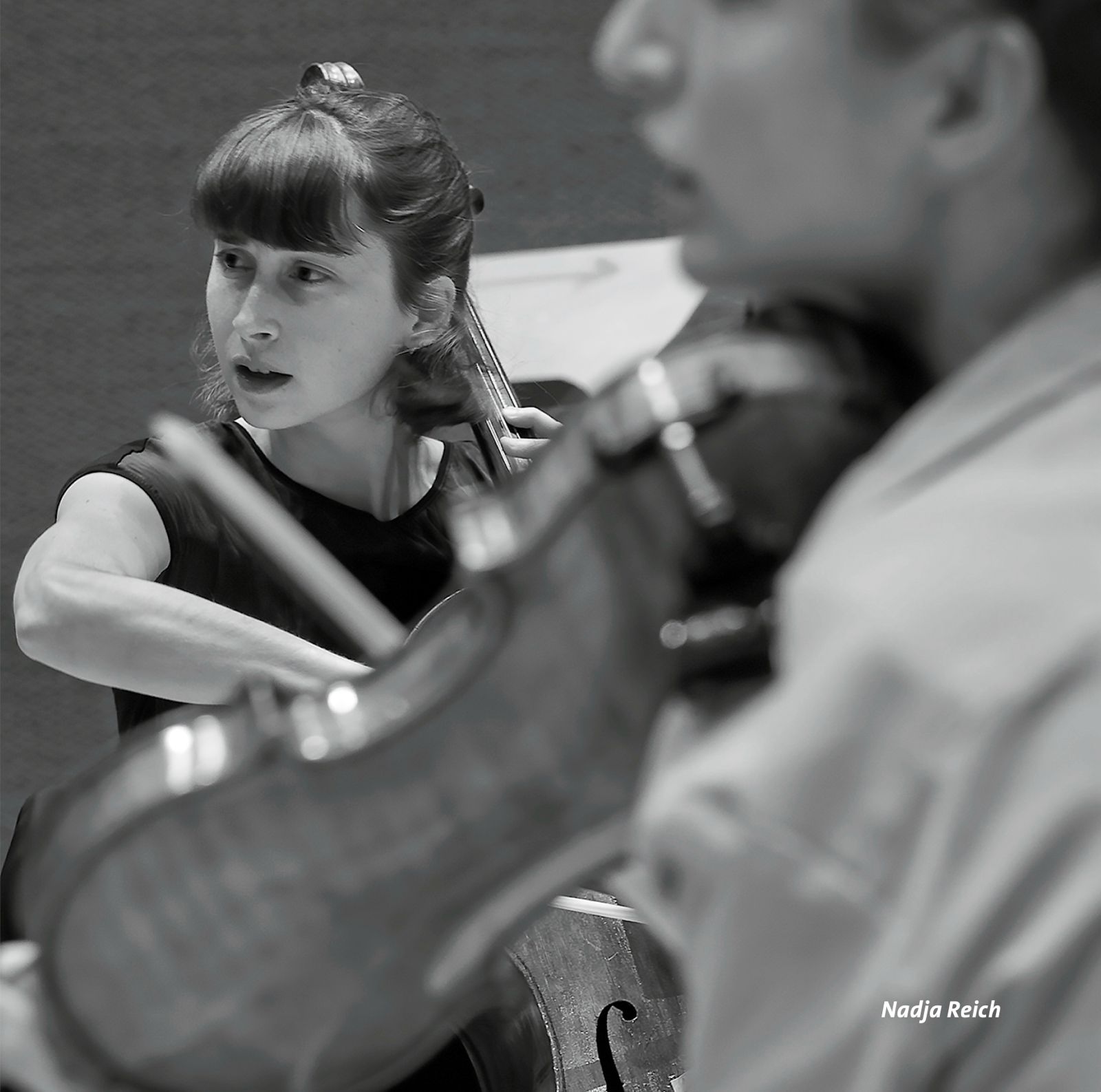
Andante con moto by Edvard Grieg
Liner Notes
Where does the journey lead,
in the single movement
that Grieg wrote
for piano trio?
In circles
the melody sounds,
at first tentative, then burning and yearning,
yet never in the same way.
The three become one, become two,
and suddenly three again,
nimble and delicate,
a glowing melt.
At times like water,
full of stormy force,
then trickling and gentle,
– and how it dances –
at times like light breaking on water,
shimmering and clear,
a game it may be,
yet a serious one.
Now leading, now following,
through dense thickets and open spaces,
playful and dreamy,
always listening
to what is there.
Where does the journey lead?
It returns to the beginning,
draws a curve,
wide and
quiet –
reaches a bright blue,
you can hear it clearly,
rooted in the earthy, wise.
Maria Reich
Trio in A major for Piano, Violin and Violoncello, formerly attributed to Brahms
It was probably a mixture of pride of ownership, the thrill of discovery, scholarly enthusiasm and a musical “tunnel vision” that led the musicologists Ernst Bücken and Karl Hasse, in 1938, to publish a piano trio in A major under the name of Johannes Brahms with the renowned publishing house Breitkopf & Härtel.
This publication had a backstory that should first be briefly outlined: as early as 6 June 1925, the work had been performed publicly at the “Fourth Rhenish Chamber Music Festival” at Brühl Palace. Its manuscript, which bore no composer’s name, had been acquired by Bücken in 1924. When the festival programme was announced, the scholarly advisers, the festival organisers and the members of the piano trio ensemble — Max von de Sandt, piano; Walter Schulze-Prisca, violin; Michael Schneider, violoncello — were evidently not in agreement as to whether they should already name Brahms, the name that was virtually on the tip of their tongues, before the trio’s performance or not. Reports in daily newspapers and music journals tended largely to accept Brahms as the composer of the trio, although there were also more or less sceptical voices.
For more than a decade thereafter, nothing more was heard of the work. Then Karl Hasse, later to become co-editor of the edition, performed the A major Trio twice as pianist together with two string-playing colleagues — Georg Beerwald, violin, and Hans Münch-Holland, violoncello. By then, the work was straightforwardly attributed to the young Brahms: first on 6 December 1936 in Cologne at a “morning celebration” organised by the “NS-Kulturgemeinde” and the Cologne Musikhochschule, and then on 10 October 1937 at the “Bergisches Brahmsfest” at Schloss Burg on the Wupper, today part of the city of Solingen. Bücken was present at both events, gave an introduction to the programme on each occasion, and explained why, in his view, the trio had been composed by the young Brahms in the summer of 1853.
The same line of argument is found in the essay “A Newly Discovered Early Work by Johannes Brahms”, which Bücken published in the journal Die Musik in October 1937, as well as in his preface to the printed edition of autumn 1938, in which Hasse’s subsequent critical report likewise argued unequivocally in favour of Brahms’s authorship. Further performances of the trio in various German cities can be documented for 1938/39, before the Second World War, which originated in Germany, made debates about the authorship of a chamber music work seem a matter of secondary importance.
In the second half of the twentieth century, the A major Trio was occasionally performed as a composition by Brahms, while the question of authorship was answered in differing ways in the Brahms literature. Shortly after the publication of the printed edition, the attribution to Brahms had generally been accepted, partly because Bücken’s and Hasse’s professional authority was trusted, and partly because controversial artistic debates were widely unwelcome during the National Socialist period. Later, however, scepticism prevailed.
Some piano trio ensembles included the A major Trio in their “complete recordings” of Brahms’s piano trios — for example the legendary Beaux Arts Trio or the Trio Fontenay. As a rule, the early B major Trio op. 8, published in 1854, was then omitted by way of compensation, so that, paradoxically, only the later version of op. 8, published in 1891, represented the early opus 8, although this version — especially in the outer movements — is in fact an entirely new composition based on the old opening themes.
This first brief overview must now be expanded into a more detailed investigation and critical examination of the authorship claimed by Bücken and Hasse. Even Breitkopf & Härtel itself now adds a question mark to the name “Brahms” in more recent reprints of the work.
Let us first ask more precisely how the “discovery”, the first performances and assessments of the trio, and its publication came about. The research and its results are, on the one hand, fascinating and, on the other, frustrating.
The Cologne-based musicologist Ernst Bücken (1884–1949), who in the 1920s adopted and further developed the method of stylistic criticism, purchased at a Cologne auction in 1924 a collection of musical manuscripts from the estate of the musicologist, collector and patron of music Erich Prieger (1849–1913), who had died in Bonn. Among them was what Bücken believed to be a copyist’s manuscript of a completely unknown Piano Trio in A major, bearing no indication of the composer’s name.
As mentioned above, Bücken arranged for the work to be performed in Brühl in 1925 as the composition of “a master whose identity is, for the time being, still unknown.” Yet in the announcements preceding the event, the publicity-friendly name “Brahms” had already appeared explicitly—sometimes accompanied by a cautious question mark, sometimes not. In the festival programme booklet, however, Bücken, as owner of the manuscript, warned that before any secure attribution could be made, “the scholarly circumscription of the unknown composer must have been completed seamlessly, down to the very last circle.”
He attempted precisely this circumscription in his introductory lectures to the manuscript performances in Cologne and at Schloss Burg (1936–37), in his article published in 1937, and in the preface to the printed edition of 1938. For him, there was no doubt that the A major Trio was a work composed by Brahms during the summer of 1853, specifically during the composer’s stay in Bonn-Mehlem while on his “great artistic journey of the summer of 1853.”
To Bücken, the unmistakable echoes of Robert Schumann’s musical language reflected what he regarded as the young Brahms’s “first serious engagement” with Schumann’s music. According to Brahms’s own account, he had first become acquainted with Schumann’s works only in September 1853 while staying with the Deichmann family in Mehlem (today part of Bonn), browsing through their music library. Bücken therefore concluded that the A major Trio must have been written at roughly the same time as the B major Trio, Op. 8, completed in January 1854, and that both its formal construction and its overall character appeared “typically Brahmsian.”
Karl Hasse reinforced this opinion in the editorial report accompanying the printed edition. Like Bücken, he maintained that “there is no possibility whatsoever of assigning the work to any other composer, for instance to an imitator.” The trio’s “musical language,” he argued, was “unique in its kind and belongs entirely to the personality of Brahms and to his particular historical mission.”
Especially in Hasse’s case, however, the argument often remained vague, speculative and highly subjective. Bücken, for his part, remarked rather smugly that the manuscript’s previous owner, Erich Prieger, “had failed to recognise its significance.”
The critical reception of the Brühl performance thirteen years earlier had, however, been far more differentiated—and considerably less unanimous. Most reviewers acknowledged how difficult it would be to prove Brahms’s authorship beyond doubt, while nevertheless considering such an attribution plausible.
One critic observed that the trio was “almost too polished and too amiable for the rugged young Brahms.” Another conceded that the work certainly displayed Brahmsian traits, yet felt that the development sections were “highly uneven” and suffered from a noticeable decline in inventiveness. While most reviewers rejected the possibility that any composer from Brahms’s immediate circle could have written the piece, one critic suggested that the trio, “probably wrongly attributed to Brahms,” might instead be an early work by Friedrich Gernsheim (1839–1916). Curiously, eleven years later the very same reviewer—by then a professor at the Cologne Conservatory directed by Hasse—declared that the “Piano Trio by Brahms […] unmistakably belongs stylistically to his early period.”
Only one reviewer dismissed the work outright, describing it as “a rather weak composition” that could at best be assigned to “a minor musician of the closing decades of the nineteenth century.”
From today’s perspective, it is deeply regrettable that the manuscript purchased by Bücken in 1924 disappeared after the publication of the trio, most likely as a casualty of the Second World War. Even more frustrating is the fact that neither Bücken’s article of 1937 nor the first printed edition of 1938 reproduces even a single page of the manuscript, while the editors’ description of it remains remarkably brief.
As a consequence, later Brahms scholars were deprived of the possibility of comparing the handwriting in order to determine whether the copyist might also have worked for the young Brahms. At least Bücken and Hasse both noted that, towards the end of the first movement, a compositional alteration had been entered by another hand, repeating the opening of the principal theme.
In Hasse’s rather quaint terminology, characteristic of his time, this intervention had been written in “the cultivated handwriting of an intellectually refined individual,” yet the additional measure introduced “a formalistic element into a movement whose overall character flows entirely from the soul.” Accordingly, the alteration was ignored in the printed edition.
The inadequate description of the manuscript, the absence of any serious investigation into its provenance, and the generally superficial musicological reasoning all reveal that Bücken was not an experienced musical philologist and that his enthusiasm over the discovery prevented a truly critical assessment. The same applies even more strongly to Hasse’s arguments.
Only a few of the weaknesses in the editors’ reasoning need be mentioned.
Bücken believed that Brahms’s authorship—and the work’s supposed origin during the composer’s stay in Bonn-Mehlem—could be demonstrated not only through stylistic analysis based on its unmistakable Schumannian echoes, but also through what he regarded as the manuscript’s place of discovery: Bonn itself.
He assumed that in late summer 1853 Brahms could have joined forces with two musicians then active in Bonn—the violinist Wilhelm Joseph von Wasielewski and the cellist Christian Reimers—to form “an excellent piano trio ensemble.”
In an article published at almost the same time as the trio’s first printed edition, the music librarian Wilhelm Altmann even transformed Bücken’s speculation into what he called the “highly probable assumption” that the manuscript had originally belonged to Wasielewski himself.
These conjectures, however, are questionable on two counts. First, Brahms did not remain in Mehlem throughout the whole of September 1853. During the second half of the month he undertook a several-day Rhine journey with the sons of the Deichmann family. It is therefore scarcely conceivable that within such a short period he could have explored the Deichmann music library in depth, become thoroughly acquainted with Schumann’s music, composed an entire piano trio, and rehearsed it with fellow musicians.
Secondly, Bücken entirely overlooked one obvious fact: according to both his own and Hasse’s description, the manuscript he had acquired consisted only of a piano score—not of separate string parts. Yet such parts would inevitably have been required for any performance of the work, regardless of who had composed it. (For the performances before publication in 1924 and 1925, Bücken undoubtedly had new performing parts prepared.)
Bücken’s and Altmann’s reflections on Bonn as the manuscript’s “place of discovery” therefore rest far more on biographical speculation than on historical fact. As already mentioned, Bücken had acquired the trio manuscript together with a number of other musical manuscripts from the estate of Erich Prieger, the philologist, musicologist and manuscript collector who was born in Bad Kreuznach in 1849 and died in Bonn in 1913.
Prieger studied philosophy in Heidelberg and Leipzig and received his doctorate in Berlin in 1875 with a dissertation on philosophical aesthetics. As contemporary reference works such as Hugo Riemann’s Musik-Lexikon (1919) record, he subsequently lived alternately in Berlin and Bonn. More recent research by Susanne Büchner has shown that, beginning in 1870, Prieger was officially enrolled for several years in the composition class of Friedrich Kiel at the Royal Academy of Music in Berlin, directed by Joseph Joachim. After Kiel’s death in 1885, Prieger inherited a substantial portion of his teacher’s manuscript estate.
Consequently, Bonn as the place where the lost trio manuscript was found has, in all likelihood, nothing to do with Brahms’s stay in Bonn-Mehlem in September 1853 or with Wasielewski’s activities there at the time. Rather, Bonn was simply the place where Prieger died and where his manuscript collection, including a considerable portion of Friedrich Kiel’s estate, happened to be preserved.
Instead of investigating the manuscript’s provenance, Bücken concentrated on reinforcing Brahms’s alleged authorship by means of two principal arguments.
The first was based on a letter Brahms wrote to Robert Schumann on 16 November 1853. In this letter Brahms listed the compositions he had submitted to Breitkopf & Härtel for publication and added: “I do not intend to publish any of my trios.”
Bücken knew that in July 1851 Brahms had already performed a piano trio at a private concert in Hamburg under the modest pseudonym “Karl Würth.” Since, in Bücken’s opinion, this now-lost trio could not yet have shown any influence from Schumann, the plural “trios” seemed to provide exactly the evidence he needed for the existence of the A major Trio.
However, Bücken overlooked an important fact. In October 1853, while staying with the Schumann family, Brahms also performed a Piano Trio Fantasy in D minor. Although Schumann considered it worthy of publication, Brahms later withdrew and destroyed the work. Contrary to Bücken’s implication, the plural “trios” therefore provides no convincing evidence that Brahms must have been the composer of the A major Trio.
Ultimately, the decisive argument for both Bücken and Hasse consisted of several themes that sounded unmistakably “Brahmsian.” These apparently led the editors—and many later supporters of the attribution—to view the work almost exclusively through the lens of Brahms. Equally obvious echoes of Schumann, Beethoven or Schubert were interpreted merely as signs of the young Brahms engaging with those composers rather than as evidence pointing elsewhere.
It cannot be denied that the opening theme of the first movement inevitably sounds “like Brahms” or “after Brahms.” The warm middle register in which the theme begins, its characteristic intervals of thirds and sixths, and, at least initially, the repeated superimposition of three half-note units over the underlying common time could indeed have been conceived by Brahms—or consciously modelled on his style.
Indeed, the invention of a number of striking and memorable themes and motives—regardless of whether they evoke Brahms, Schumann, Beethoven, Schubert or even the then politically ostracised Mendelssohn—is undoubtedly one of the anonymous composer’s greatest strengths.
Yet it is equally undeniable that works by Brahms’s contemporaries, as well as by younger composers born in the middle or later decades of the nineteenth century, repeatedly contain themes, gestures and musical idioms that are remarkably Brahms-like.
Examples include Brahms’s close friend Albert Dietrich, particularly passages from the development section of the first movement of the famous F.A.E. Sonata composed jointly by Schumann, Brahms and Dietrich for Joseph Joachim; Carl von Holten, Brahms’s fellow native of Hamburg, whose Violin Sonata, Op. 5 contains an unmistakably Brahmsian secondary theme; Heinrich von Herzogenberg, ten years Brahms’s junior and one of his most devoted admirers, whose First Symphony in C minor, Op. 50, as well as the enchanting piano prelude to the vocal quartet Nachtlied, Op. 73 No. 1, frequently recalls Brahms’s musical language; and even the very young Max Reger, whose Piano Trio, Op. 2 displays striking Brahmsian characteristics in the second subject of its opening movement.
The possibility that another young composer—or perhaps even a female composer—might simply have paid tribute to admired musical models during the second half of the nineteenth century was categorically ruled out by Bücken, Hasse and many others. They repeatedly insisted that both the artistic quality of the trio and certain compositional procedures could only have been achieved by Brahms himself.
Although they occasionally pointed to techniques such as the rhythmic expansion of a motive at the conclusion of a movement, they overlooked the fact that such procedures formed part of the standard compositional training of the nineteenth century.
Far more significant than identifying conscious or unconscious reminiscences of Brahms in the A major Trio is another question: does this work display anything approaching the compositional mastery found in Brahms’s early Piano Sonatas Opp. 1, 2 and 5, the Scherzo for Piano Op. 4, the songs Opp. 3, 6 and 7, or the ambitious conception and expressive depth of the Piano Trio in B major, Op. 8, composed and completed at the beginning of 1854?
Several reviewers of the Brühl performance in 1925 answered this question more critically than did later commentators writing after Bücken and Hasse had invested the work with the seemingly unquestionable authority of musicological scholarship. In comparison with Brahms’s earliest published compositions, the A major Trio falls noticeably short.
While many thematic ideas throughout the work are remarkably memorable and occasionally strikingly Brahmsian, their subsequent treatment, development, transformation and expressive reinterpretation are considerably less sophisticated than in Brahms’s works of the years 1851–1854.
The first movement illustrates this particularly clearly. The capricious figure of dotted and later even semiquavers first appears inserted into the secondary theme and subsequently returns several times without undergoing any meaningful development or giving the movement a genuinely new direction or expressive significance. Apart from its rhythmic broadening near the close of the movement, it functions merely as a brief contrasting gesture, almost stamped onto the musical surface rather than organically integrated into the composition.
Composers from Brahms’s circle, such as Albert Dietrich, Friedrich Gernsheim or Heinrich von Herzogenberg, handled the technical and expressive development of their thematic material with considerably greater imagination and compositional skill, even if their themes themselves were perhaps less immediately memorable or sensuously appealing than those found in the A major Trio.
Nevertheless, the Scherzo—with its rugged, passionate Vivace and its Trio section opening with touching lyricism before gradually losing some of its coherence—or the dreamlike passages of the slow movement, meditating over a dotted rhythmic motive, possess a distinctive charm of their own, even if that charm cannot necessarily be regarded as specifically Brahmsian.
The importance—indeed, the decisive importance—of the compositional development of an initial musical idea within Brahms’s creative process becomes apparent not only in the early works mentioned above but also in several of his later, strikingly explicit statements. Thus Brahms once remarked to his friend Georg Henschel:
“What people call invention—a genuine musical idea—is, so to speak, a higher inspiration, a gift. For that I can claim no credit. From that very moment, however, I cannot despise this ‘gift’ enough; I must transform it, through unceasing work, into my rightful, hard-earned possession.”
This “unceasing work,” which already characterises so much of Brahms’s early output—even if not always with the same degree of concentration as in his later masterpieces—is far less evident in the A major Trio. Here, the anonymous composer appears to value the individual themes and musical ideas themselves more highly than what can be developed from them.
This is equally true of the principal theme of the finale, which begins with an impetuous energy recalling Beethoven. As the two opening thematic phrases successively outline A major and E major with chromatic inflections and contrapuntal motion, they evoke so strongly the relationship between dux and comes in a fugue that one naturally expects an extended fugal or at least fugal-like passage to follow.
Unlike the opening movement of Brahms’s early Piano Trio, Op. 8—where the fugue-like implications of the exposition are only fulfilled in the recapitulation and significantly redirect the musical course—this expectation is never truly realised in the finale of the A major Trio. Although the development contains a brief imitative section based on the opening of the principal theme, this fragment of fugal writing is preceded by a much longer passage in which the theme, so clearly inviting contrapuntal treatment, is merely broadened rhythmically, led through a succession of keys and accompanied, almost helplessly, by simple broken chords in the piano. One can scarcely imagine even the young Brahms resorting to such a solution, even in his least inspired moments.
This brings us to one final argument still frequently advanced by defenders of Brahms’s authorship. They contend that Brahms may simply have rejected or forgotten the A major Trio because it failed to satisfy his own extraordinarily demanding standards, while adding that the work nevertheless deserves to be performed and appreciated despite the composer’s rigorous self-criticism.
There are indeed several later examples in Brahms’s oeuvre in which he withdrew an earlier version of a work—for instance the slow movement of the First Symphony, as well as the songs Mein wundes Herz, Op. 59 No. 7, and Lerchengesang, Op. 70 No. 2. Yet comparison between the discarded and the published versions demonstrates that Brahms was distinguishing not between successful and unsuccessful compositions, but between what he regarded as optimal and what he considered merely somewhat less convincing. The same uncompromising artistic standard characterises works that remained unpublished during his lifetime, such as the first version of Regenlied (WoO post. 23) or several choral compositions.
With regard to the A major Trio, therefore, almost every available piece of evidence argues against Brahms’s authorship. This is also reflected in the fact that the work was not included in the New Complete Edition of Brahms’s works. Philological observations and the surviving evidence concerning the manuscript likewise point in the same direction.
As the American Brahms scholar George S. Bozarth and the present author have observed, several performance indications in the A major Trio differ strikingly from those typically found in Brahms’s early compositions. The markings cant., cantabile and con affetto, which occur repeatedly throughout the trio, are absent from the young Brahms’s authentic works, while the dynamic marking mf (mezzo forte), which Brahms generally used only sparingly and never particularly favoured, appears comparatively frequently in this composition.
Ironically, it may be precisely the anonymous transmission of the manuscript—lost after 1938—that provides the clearest indication of the work’s true origins. Other musical manuscripts acquired by Bücken from the Prieger estate and preserved today in the University and City Library of Cologne likewise bear no composer’s name. Their musical language varies so considerably that they can hardly all have originated from a single composer.
Among these manuscripts is a Piano Quartet in A major whose style appears to belong to the early period of Beethoven or perhaps Johann Nepomuk Hummel. In its thematic material and developmental procedures—especially in the first two movements—it follows Beethoven’s Piano Quartet, Op. 16, so closely that one is tempted to regard it as a compositional exercise assigned by a teacher to a student.
This manuscript shares several characteristics with those Bücken described for the A major Trio. Although, unlike the trio, it possesses a title page, the composer’s name is again absent, and a later hand has simply added a question mark in pencil.
It therefore seems likely that the lost manuscript of the Piano Trio published by Bücken and Hasse under Brahms’s name originated, like these other anonymous manuscripts, from the estate of the distinguished composer and composition teacher Friedrich Kiel. After Kiel’s death it passed into the possession of his former pupil Erich Prieger and was eventually acquired by Bücken in 1924 as part of a large “collection of older and more recent manuscript copies of every description.”
Friedrich Kiel himself can almost certainly be excluded as the composer. Far more plausible is the assumption that the trio represents the work of one of the students in Kiel’s composition class. If the surviving manuscript was indeed a copy prepared by a professional copyist, the alteration entered near the end of the first movement was most likely made either by the composer himself or by Kiel as the work’s teacher.
The future of this attractive trio—with its memorable and thematically compelling musical ideas, yet without attaining the compositional sophistication of Brahms’s works from the first half of the 1850s—remains to be seen. Will it continue to be performed, appreciated and enjoyed to the same extent if it is announced not as a composition by the young Brahms, but rather as a “work by an unknown composer, formerly attributed to Brahms”?
Much will undoubtedly depend on the quality and artistic conviction of its performance.
© Dr Michael Struck, 2026
Translated from the original German.
More detailed information and documentation of the quotations cited in this essay can be found in:
Johannes Brahms. Neue Ausgabe sämtlicher Werke, Series II, Volume 6a: Klaviertrios I: No. 1 in B major, Op. 8, 1854 edition – “New Edition” 1891, edited by Michael Struck, Munich, 2025, pp. XVII–XXIX (chapter: “On the Questionable Authenticity of the Piano Trio in A major, Appendix IV No. 5”).
More Releases